A book. Loose cards. Handwriting. Wooden pieces. A hand with a hammer.
A working text and a register of found things. Learn the symbolic vocabulary, try the study prompts, and keep a record. The gaps stay visible.
G/03 · pieces which fit, or nearly fit.
The working text
Study leaves / v2
Read it. Try something small. Keep a record. Come back.
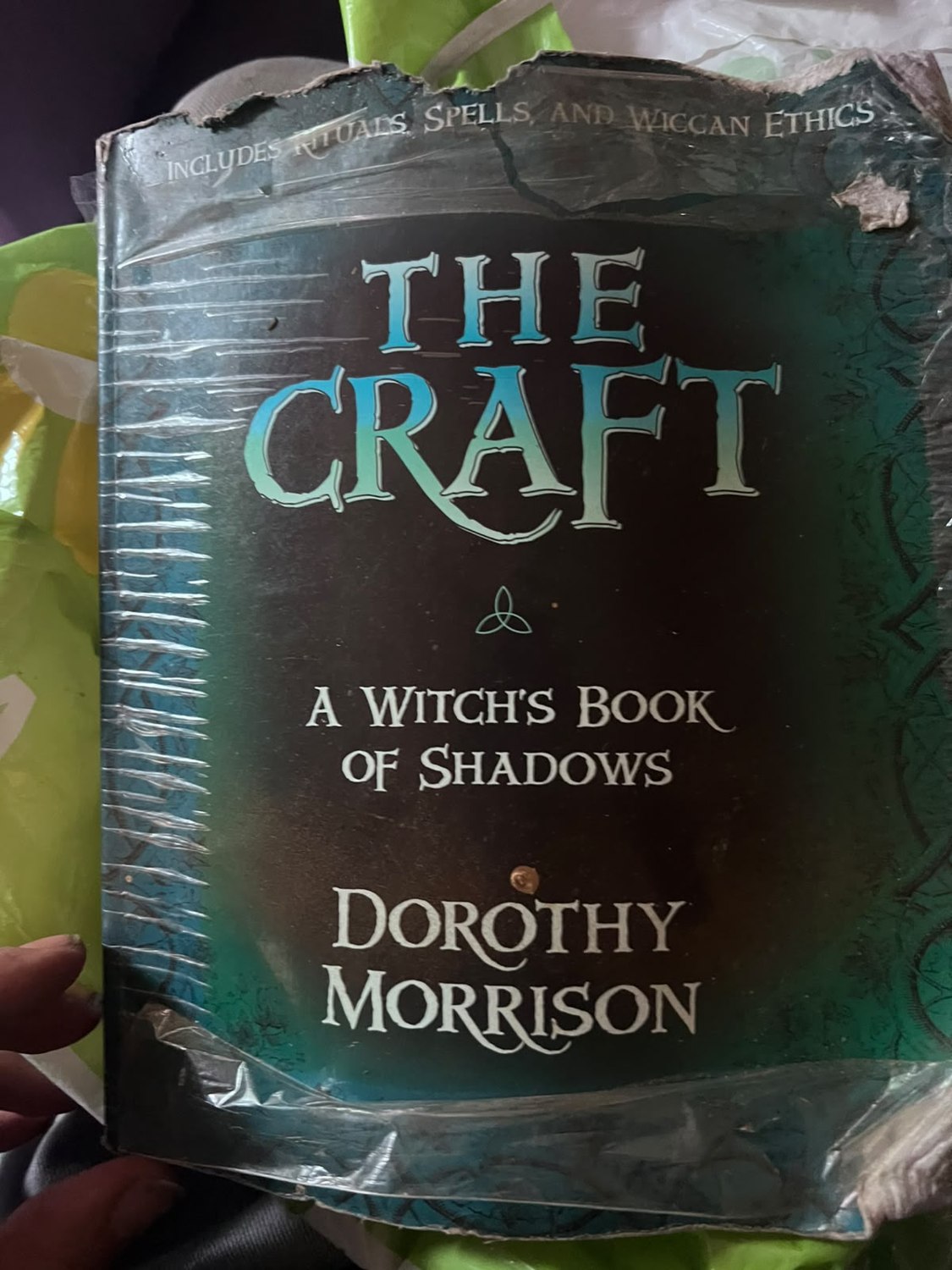
This is a study companion to the photographed pages of Dorothy Morrison's The Craft: A Witch's Book of Shadows. It explains selected ideas in new words; it is not a transcription or a complete account of Wicca. The exercises marked Guild practice are new study prompts, not Morrison's instructions. The photographs remain the found objects from which this arrangement began.
Study leaf 01 / Walking the path
The Rede: a shape for conduct
The visible Rede is verse doing several jobs at once: setting a social ethic, describing ritual movement, and making a calendar of moon and wind. Its opening connects trust and affection with reciprocity. The phrase Live and let live is immediately paired with fair exchange. It is not a licence to take whatever you want.
Other visible lines ask for restraint in speech and careful listening. They describe circling, rhyme, clockwise movement with a growing moon and counterclockwise movement as it diminishes. The poem carries these instructions through images and rhythm, making them easier to remember. That is the form to notice: behaviour, ritual and seasonal observation held together rather than separated into a rulebook.
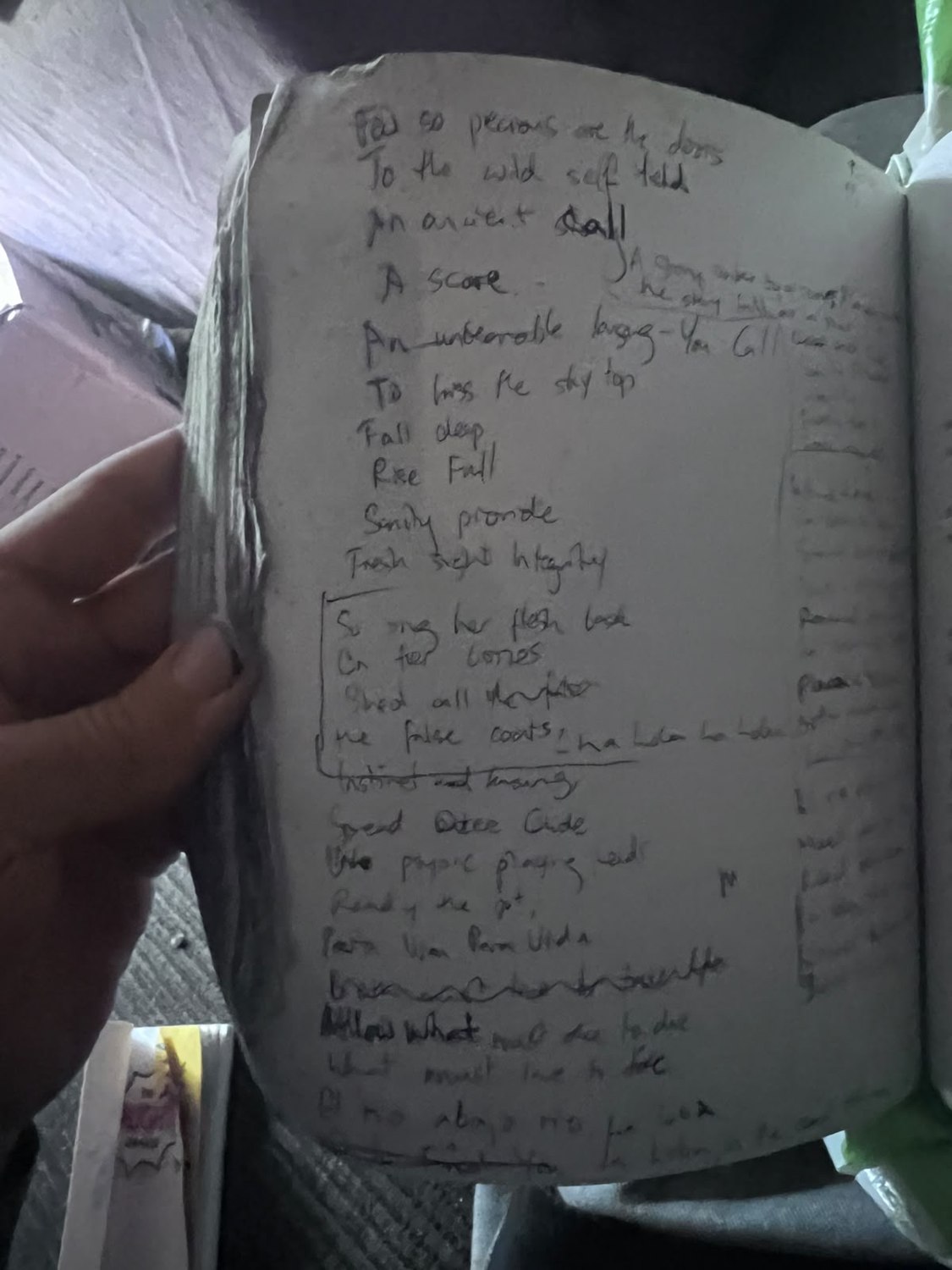
The photographed page stops during the poem. This guide does not pretend it has the whole Rede. The surrounding prose makes good manners and judgment central to the path. For study, ask what a proposed working does to the people around it, not only whether it fits a ritual formula.
Guild practice / Test an intention
Write one sentence naming what you want. Under it answer: who might be affected, whose choice might be displaced, what would count as fair exchange, and what ordinary action could pursue the same aim? Rewrite the intention so it concerns your own conduct. Make them love me becomes Help me speak honestly and accept their answer. That revision changes the ethical structure, not merely the wording.
Photographed source: Walking the Path / Rede of the Wicca.
Study leaf 02 / Working with major power sources
The charges: voices, not recipes
A charge is presented here as a deity's address to participants in ritual. The Goddess speaks through the priestess; the God through the priest. In the photographed rhyming passages, divine identity is spread across ordinary sensory life: birds, moving water, rain, warmth, growing plants, ageing and birth. Read the repeated first-person voice as a way of recognising sacred presence in the world.
The Goddess passage joins the life cycle to tenderness and care for the Earth and its creatures. Its continuation directs the seeker inward. The God passage draws on sun, forest, desire and experience. The prose gives him three aspects: youth, the father or horned/green figure, and the ancient figure. These are the source's theological images, not fixed identities assigned to any person in the dump.
There is a useful difference between the charge and a spell. The charge establishes a relationship and a view of the world. A spell sets an intention within that view. If you miss the first layer, the second can become a collection of gestures with no understood purpose.
Guild practice / Read an image slowly
Choose one motif, such as rain on soil. Record the sensation it calls up, the life process it points to, and the responsibility it might suggest. Then write your own four-line address from a place or season. Label it as yours. Do not pass new writing off as a recovered charge.
Photographed source: Rhyming Charge of the Goddess / The God / Rhyming Charge of the God.
Study leaf 03 / Knowing yourself
The elements: a vocabulary you can work with
In these pages, elements connect qualities of attention and behaviour with ritual correspondences. Air concerns thought and communication. Fire concerns initiative and activity. Water concerns feeling. Earth concerns practical grounding. This is a symbolic map: anger is not literally fire, and patience is not a substance made of earth.
Morrison asks the learner to look at helpful and troublesome qualities together, assign elemental associations, and notice imbalance. The important move is to examine yourself before trying to direct anything outside yourself. A strength can become a problem when it occupies every situation: determination can harden into refusal to listen; energy can become irritability.
Air / Thought
Ask whether an idea has been expressed, questioned and understood. When thinking feels stuck, use writing or conversation to make it visible.
Guild practice: explain one confusing idea in three sentences, then list what you still do not know.
Fire / Action
The photographed correspondence is red and south. Its chart sets movement and courage against destructive or excessive states. More drive is not always better.
Guild practice: choose one unfinished task, give it ten minutes, then stop and record what actually changed.
Water / Feeling
The photographed correspondence is blue and west. Its imagery is receptive and contracting, in contrast to Fire's expansion. Make room for feeling without making it the only evidence.
Guild practice: name an emotion, what brought it on, and what you need. Keep the event separate from your interpretation.
Earth / Grounding
The practical exercises turn toward plants, the body, animals and the ground. Bring the work back to something tangible and maintained.
Guild practice: water a plant or tidy a small surface. Describe the result in physical terms, without a claim about invisible energy.
Make a balance sheet, not a verdict
Draw two columns: helps me and gets in my way. Add examples from this week, not permanent labels about who you are. Mark each with the element that seems useful. If everything looks like Fire, ask whether you are overlooking thought, feeling or maintenance. The map should open possibilities, not diagnose you.
The source proposes a month of activities before making a fresh list and comparing it with the first. Treat that as an observation interval, not a promised transformation. Its Air exercise also pairs imagined intention with breathing. For a gentle adaptation, breathe normally while silently naming a quality you want to practise. Do not force the breath or chase the book's increasing counts.
Photographed source: Knowing Yourself, pp. 24–25 / Fire / Water. Other element pages are blurred or incomplete, so a full correspondence chart has not been reconstructed.
Study leaf 04 / The ultimate magical tool
The mind before the implement
The chapter identifies the brain as the tool that bought or handmade objects cannot replace. Its exercises move through remembered objects, imagined sound and sensory recall. The learning target is sustained attention: can you call up a detail, keep track of it, and notice when it slips?
The note to the reader says that weekly divisions are starting points, not deadlines for mastery. That matters. Repetition without observation is only repetition; observation without repetition may leave you with one memorable attempt rather than a skill.
Guild practice / A two-minute attention test
Look at an ordinary object for thirty seconds. Notice shape, texture, shadow and one small flaw.
Turn away and sketch it or describe it from memory for one minute. If visual imagery is difficult, use words or spatial relations instead.
Look again. Circle one accurate detail and one detail you supplied that was not there.
Record what distracted you. Try again another day with the same time limit.
The test is not whether your image seems vivid. It is whether your record becomes more accurate. An imagined sound is something you choose to imagine, not evidence of an external voice.
Photographed source: A Note to the Reader / The Ultimate Magical Tool / Mental Theory: Focal Retention, p. 101.
Study leaf 05 / Magical tools
Wand and athame: direction and boundary
The photographed tools chapter treats implements as personal extensions of a practitioner. Making or personalising them gives them a particular relationship to the user. It also insists that you do not touch or borrow another person's tools without permission. Whatever you think of the magical explanation, the privacy rule is plain.
The athame chapter distinguishes two functions that can look similar in use. The wand moves or directs energy within the source's model; the athame invokes and banishes, setting terms for what may enter or remain. Its photographed correspondences are Fire, south and red, with a male designation in Morrison's tradition. The book itself notes that traditions may differ. These are not universal requirements.
The wand exercises pair clockwise circling with directing attention toward an object, and counterclockwise circling with rejecting it. The first exercise uses an imagined sound; the second works on whether an out-of-place object keeps attracting notice. You can study this contrast as attention versus withdrawal of attention without claiming that a cup has become audibly enchanted or has physically vanished.
Guild practice / Practise the distinction safely
Use a finger or an unsharpened stick. No blade is needed.
Put a cup on a clear table. Trace a circle clockwise around it, without touching it. Name one quality you intend to bring to a task, such as patience.
On a second sheet draw a boundary. Name a distraction you intend to leave outside it. Trace counterclockwise, then put the distracting item away using ordinary means.
Work for five minutes. Record whether the gestures helped you begin or stay with the task.
The circle is a deliberate cue. It does not substitute for locks, physical distance, medical care or another person's consent.
Photographed source: Magical Tools / The Wand / Small Wand Exercises, weeks three and four / The Athame.
Study leaf 06 / Boosting the magic
Trees: material has a history
The trees page links parts of a tree with different symbolic jobs. Underground parts suggest stability and grounding. Trunk materials suggest bodily and emotional concerns. Leaves and flowers suggest freedom and guidance. It also assigns particular associations to species: apple appears with love and birch with beginnings. These are entries in a ritual vocabulary, not medical properties.
The wand-making pages slow acquisition down into relationship: visits, attention, a request, and thanks before harvest. Read the practical lesson as resistance to taking material casually. The dump does not give us a complete safe harvesting manual. A feeling of permission from a tree does not replace the landowner's permission or rules protecting the tree.
Guild practice / A material record
Start with a fallen twig where collection is allowed, or simply observe without taking anything. Record the location in your private notes, how the material came to you, what you can reliably identify, and what you cannot. Choose a symbolic use from the part's form: roots for keeping steady, branching for alternatives, leaves for change. Say that the association is chosen, not scientifically discovered.
Do not cut living branches for this exercise. Do not ingest, burn or apply unknown plant material. A drawing can do the study work without consuming the tree.
Photographed source: Trees / The Wand / Wand Harvest.
Study leaf 07 / Correspondences
Colour: choose a cue, know why
The photographed colour page offers a palette of intentions. Recast as a working reference, its associations run as follows. They are Morrison's symbolic choices, not guarantees about what a colour makes people feel or do.
Peach / Pink
Gentleness and reassurance / affection toward oneself and others.
Purple / Red
Authority and spiritual work / vitality, taking charge and Fire.
Silver / White
Goddess imagery and calm / clarity, guidance and a general-purpose substitute within the source's system.
Teal / Turquoise
Practical decisions held alongside spiritual concerns / stepping back from work, study and retention.
Guild practice / Make a deliberate choice
Take a piece of coloured paper or make a mark in your notebook. Write the quality it will remind you to practise and one action that would express it. A teal mark for decision-making might accompany a list of options and consequences. The mark supports the decision; it does not make it for you.
If a colour means something different in your experience, record the difference. A personal association can be useful without pretending it is the photographed author's association. You do not need candles, dye or a purchase.
Photographed source: Boosting the Magic / colour entries from Peach to White.
Study leaf 08 / Keep a record
The twenty-one-days rule: a claim to examine
A footnote in the photographed booster chapter gives magic a twenty-one-day window, otherwise treating the effort as unsuccessful. That is the book's rule of thumb, not an established law of causation. A deadline can help you review a working. It cannot tell you that the working caused whatever happened in that period.
Use the interval as a check against endlessly moving the goalposts. Decide what would count as a result before you begin. Include what you will do by ordinary means and what else could explain a change. If the result does not happen, record that plainly. Do not blame yourself or pay for increasingly elaborate remedies to rescue the claim.
Guild practice / A page for one working
Intention
What is within my control? Who else is affected?
Method
What symbolic action will I try, and what ordinary action accompanies it?
Observation
What did I notice? What happened outside the exercise?
Review
What changed, what did not, and what are the alternative explanations?
Next step
Keep, change or stop the practice. Give a reason.
For a twenty-one-day study, make the aim small: beginning a task, remembering details, or pausing before speaking. Review your notes at the end. Learning is a result even when the supernatural explanation remains unproved.
Photographed source: Boosting the Magic, opening page and footnote / A Note to the Reader.
Where this edition stops
The dump contains partial and overlapping pages, not a complete course. Full poems, chapter prose, unseen exercises and missing tables are not reproduced or invented. For the author's complete sequence and wording, consult The Craft: A Witch's Book of Shadows, Dorothy Morrison. This page is a selective companion, with its own study prompts clearly marked. No belief stated here is imposed as Guild doctrine.
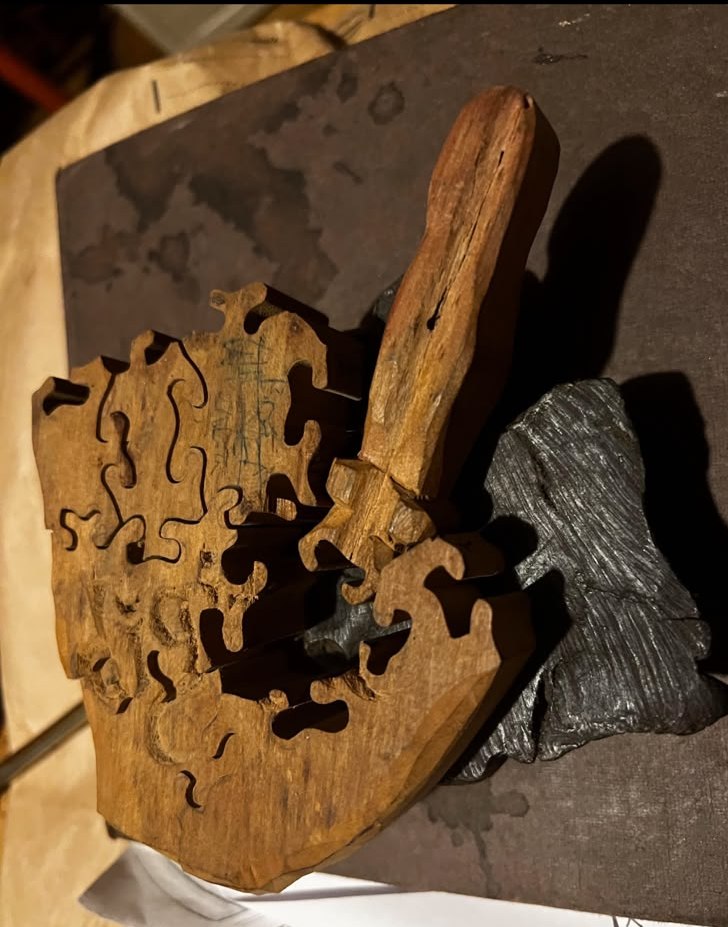
Interlocking wooden pieces, a handle and a dark backing. Function and maker are not identified. The supplied phone screenshot displays 17 Feb 2022; that is not a verified making date.
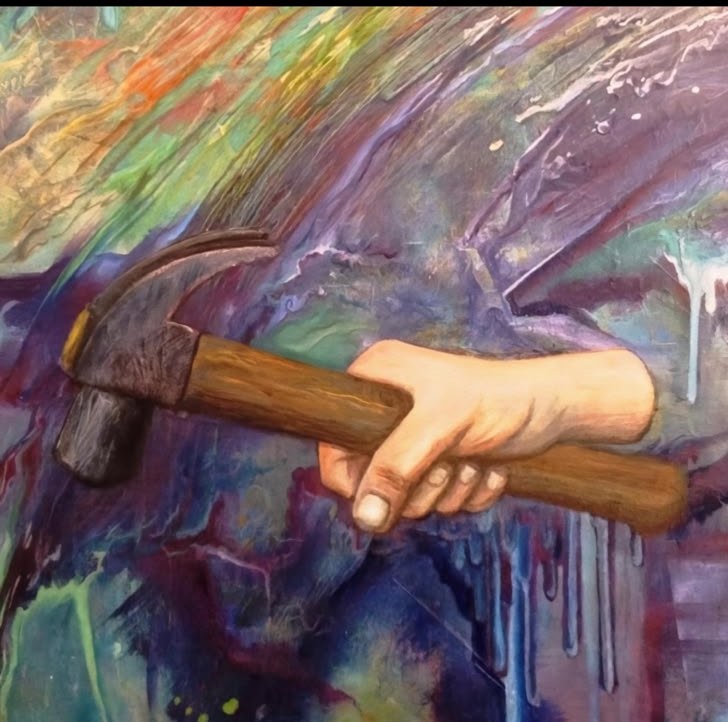
A painted hand holds a claw hammer against a coloured, running surface. Artist and title are not identified. The supplied screenshot displays 7 Oct 2022.
No match in this partial register. Try another word, or reset.
What stays partial
No invented provenance
44 source photographs were reviewed. Repeated angles and blurred pages are not repeated here. The book is represented by its cover, two heading fragments and a selective study companion, not a full readable reproduction.
Photographs of people, personal paperwork and contact details are outside this public selection. Their absence is not a statement about who matters.
Names printed on objects identify those objects. They do not identify who owned them. Photograph dates, where visible in the supplied screenshots, are not dates of manufacture.
Handwriting stays handwriting. No uncertain word has been silently repaired, and no author, relation or story has been invented for it.
Credits / handling
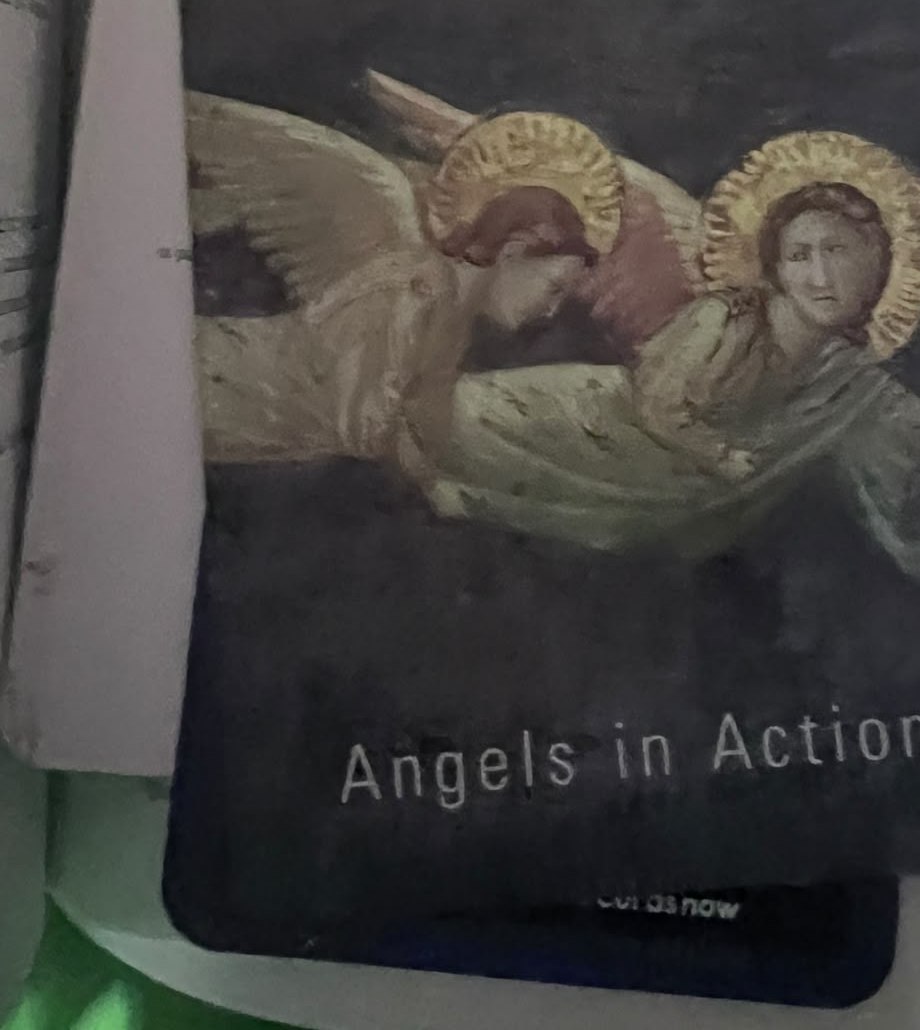
The Craft: A Witch's Book of Shadows - Dorothy Morrison, as printed on the photographed cover. The Naughty Oracle - Naomi Beth, as printed on its box. Angels in Action, as printed on the cards. Other makers and dates remain unidentified here.
Images were supplied for this record. Display copies were rotated or cropped for reading, and saved without embedded metadata. Crops remove phone-interface chrome and reduce unrelated surrounding text. Originals are not included in this page.